Modern Farmhouse Style: The Real Design and Build Guide
James Anderson
Editorial Contributor
Everyone's seen the checklist by now: black windows, shiplap, a big front porch, call it a day. That's the version of modern farmhouse that shows up in most articles, and honestly, it's why so many new builds in this style end up looking the same and dating fast.
There's more going on underneath that surface-level list. The homes that actually hold up, visually and structurally, over ten or fifteen years tend to get a few fundamentals right that rarely make it into the standard guide: proportion, material choice, and how the style adapts (or doesn't) to different climates. That's what this guide focuses on.
What Actually Makes a Home "Modern Farmhouse"
Here's a distinction worth making early: a modern farmhouse isn't a regular farmhouse with black trim slapped on. It's its own architectural language, one that takes the gabled rooflines and symmetrical layouts of old farmhouses and pairs them with something more contemporary: bigger windows, less ornamentation, open interiors.
Think of it as splitting the difference between two extremes. Traditional farmhouses can feel fussy and dated to some buyers. Pure modern design, on the other hand, can feel cold. This style sits in between structured, but still warm.
A Few Things That Actually Define the Look
- Gable rooflines, usually moderate to steep pitch
- Board-and-batten or lap siding white, gray, black are common
- Bigger windows, often with black frames
- Deep porches with simple columns
- Metal accents on porch roofs or dormers
The Part Everyone Skips: Proportion
Most people obsess over paint colors before anything else gets figured out. That's backwards. The ratio of window to wall space, how steep the roof pitch is, how deep the porch runs that's what makes a house read as genuinely modern farmhouse versus just "a house with black trim." Get the proportions wrong and no amount of color-matching saves it. Get them right, and honestly, even a fairly neutral palette will still look like the real thing.
This is the kind of detail that doesn't show up in most write-ups, probably because it's less visual and harder to photograph than a kitchen island.
Exterior Materials: What They Actually Cost
Material choice affects two things people don't always connect: how authentic the exterior looks, and what you're paying to maintain it for the next twenty years.
| Material | Cost per sq ft | Maintenance |
| Fiber cement siding |  12 | Low |
| Wood board-and-batten |  15 | Moderate to high |
| Vinyl (farmhouse-style) |  7 | Low |
| Metal roof accents |  16 | Very low |
Fiber cement has become the go-to for a reason it gets you close to the painted-wood look without the upkeep headache real wood brings. It doesn't warp, holds paint longer, and shrugs off moisture better than people expect. Most comparisons stop at "it's cheaper," which misses the actual point.
Windows and Doors
Black window frames are basically the signature of this style at this point, but the frame material matters more than people think. Aluminum-clad frames hold their finish noticeably longer than powder-coated vinyl, which can start fading or chipping within a few years if you're somewhere sunny. Worth knowing before you pick based on price alone.
Front doors usually go one of two ways: a dark stained wood door for warmth, or black steel for something sharper and more minimal. Glass panels are showing up more often too, mostly because people want the light without breaking the clean lines the style depends on.
Inside the House
Interiors lean open and bright, but with texture wood, black hardware, that kind of thing so it doesn't feel as stark as a fully modern space would.
What You'll Typically See
- Open kitchen-living-dining layouts
- Shiplap or board-and-batten accent walls
- Matte black or brass fixtures
- Wide-plank flooring
- Neutral palettes, black or navy accents
Where People Go Wrong
Here's a gap in most existing content: nobody warns you that using every trend element at once shipps on every wall, black hardware in every room is exactly what makes a house feel dated the fastest. The homes that age well usually stick to two or three signature moves, repeated with some consistency, instead of throwing the whole look at every single room.
It's a small distinction, but it's really the difference between a house that still looks good in 2035 and one that immediately screams "built in the mid-2020s."
Kitchens and Bathrooms
Kitchens tend to center around a big island, often in a contrasting finish from the rest of the cabinetry, plus an apron-front sink and a mix of open and closed shelving. Bathrooms lean into matte black fixtures, freestanding tubs, simple tile nothing too complicated, which is sort of the point.
Floor Plans
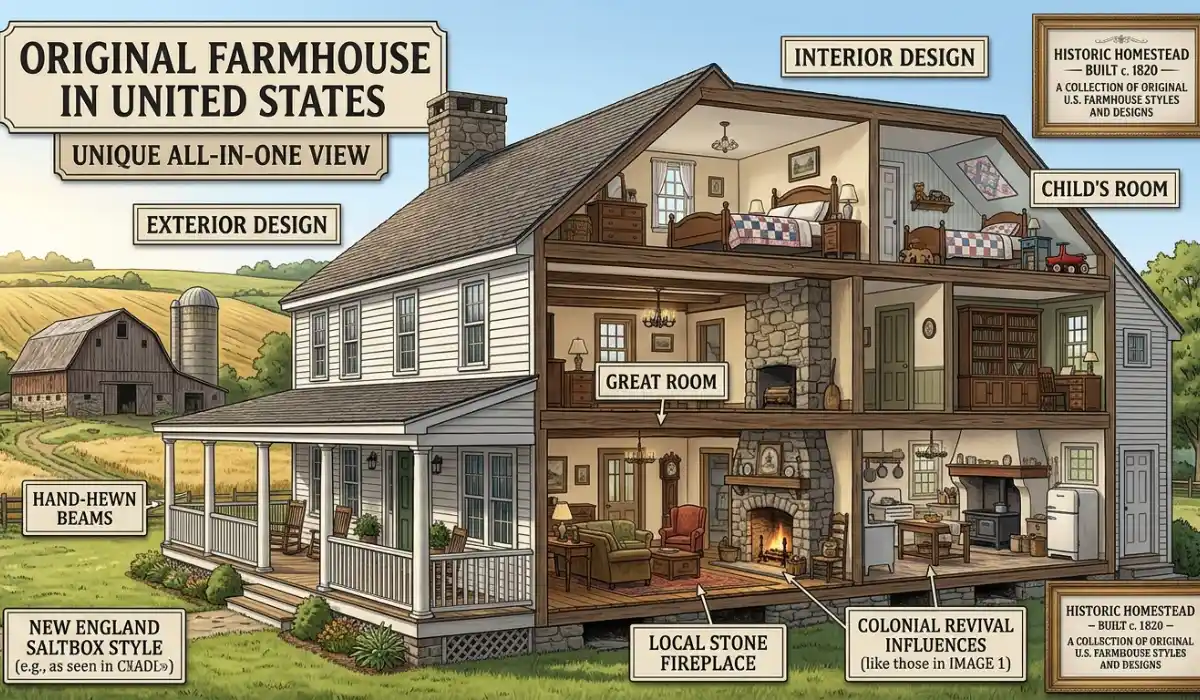
Most modern farmhouse layouts put the kitchen, living, and dining spaces together as one open area, then keep bedrooms and offices more separated, a nod to how older farmhouses actually organized space, just opened up where it matters most.
Features That Show Up a Lot
- Large islands as the natural gathering spot
- Mudrooms near back or side entries
- Bonus rooms or lofts above garages
- Covered outdoor space connected to the main living area
Two-story plans increasingly put the primary suite on the ground floor not really a style requirement, more a reflection of what buyers are asking for right now. Worth knowing if you're picking between plan options.
Weighing It Out
| Pros | Cons |
| Strong resale appeal in a lot of markets | Can look generic without attention to proportion |
| Plays well with a lot of different decor styles | Wood siding and accents need upkeep |
| Open layouts, plenty of natural light | Certain choices (all-black exterior, heavy shiplap) date fast |
| Lots of pre-drawn plans already exist in this style | Getting the "authentic" materials can cost more than generic siding |
Climate Actually Matters Here
This barely gets mentioned anywhere: dark siding and black windows soak up a lot more heat if you're building somewhere sunny, and that shows up later as a higher cooling bill. If you're in a hot climate, it's worth talking to your builder about reflective coatings or lighter accent tones instead of defaulting to all-black because it looks good in photos.
Cold Climates
Big porches and large window banks, both defining features of the style, need real attention paid to insulation and thermal breaks around the frames, or you'll lose more heat than you'd expect. Bring this up with your architect directly; standard window specs aren't always built for genuinely cold winters.
Humid or Coastal Areas
Wood board-and-batten doesn't hold up as well in humidity, more maintenance, more risk of moisture damage over time. If you're near the coast, it's worth being honest with yourself about whether you'll actually keep up with that maintenance, or whether fiber cement makes more sense despite being slightly less "authentic."
Mistakes Worth Avoiding
- Picking trim and window colors before the roofline and porch proportions are settled
- Repeating the same trend element in every single room
- Choosing real wood siding without actually planning for the maintenance
- Going all-black on the exterior without considering your climate
- Not thinking through window-to-wall proportion at all
Questions People Actually Ask
Is the modern farmhouse still in, or is it played out?
Still popular overall but the version with every trend stacked on top of each other is starting to look tired. The more restrained, proportion-focused version tends to hold up better.
What's actually different between a farmhouse and a modern farmhouse?
Traditional farmhouses lean rustic and detailed. Modern farmhouses keep the same basic shape roofline, porch but strips back the ornamentation and adds bigger windows and more open interiors.
Is the siding expensive to maintain?
Depends what you pick. Fiber cement gets you the look without much upkeep. Real wood board-and-batten looks great but needs more attention, especially somewhere humid.
Does this style even work in a hot climate?
It can, but not with an all-black exterior by default, pair dark tones with reflective coatings or go lighter on accents if cooling costs are a concern.
Can you customize a pre-drawn modern farmhouse plan?
Generally, yes cosmetic changes are easy. Structural changes, like adjusting the roofline, take longer and cost more.
What roof pitch actually looks right for this style?
Moderate to steep gable pitches read as more authentic. Go too shallow and it stops looking like a farmhouse silhouette at all.
Bottom Line
Get the proportions right first roofline, windows, porch depth before worrying about paint colors and finishes. That's really the whole secret. Builders and buyers who start there, and who actually think about their local climate instead of copying photos from a different region, end up with a house that still looks intentional a decade from now, instead of one that just looks like it followed a trend checklist.
James Anderson
Passionate about transforming houses into inspired homes. Writing about practical DIY guides, interior design, and outdoor living.